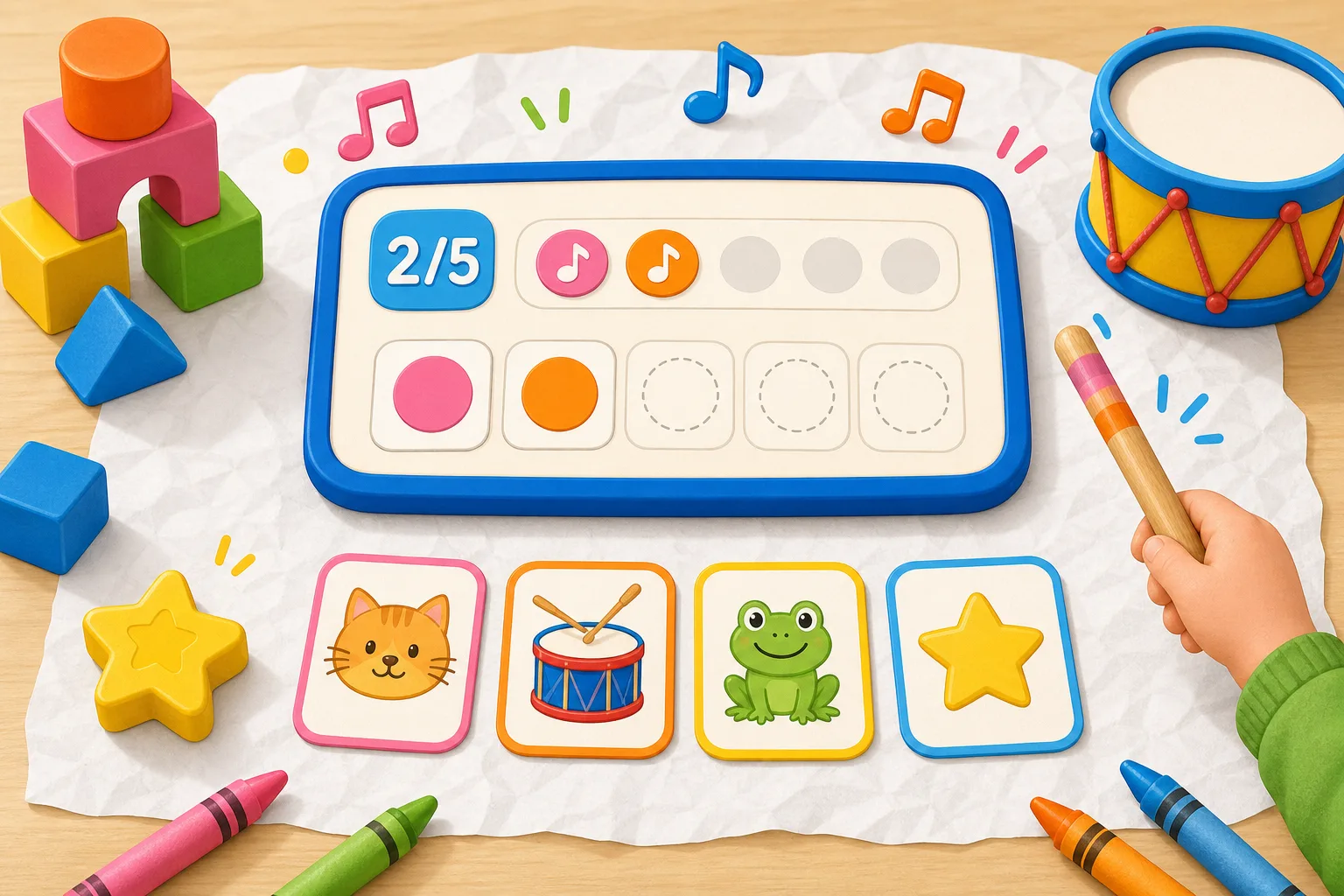
Whether this game is "educational" depends less on the game itself and more on whether the pace, categories, and expectations fit the age in front of you.
Say the Word on Beat works when the child can understand the prompt quickly and answer before frustration shows up. The same format can feel playful for one age group and overwhelming for another, so tuning it matters.
Why the format works when it works
The game combines a quick visual cue with a spoken answer and a simple beat. For younger children, that helps connect pictures to words. For older children, it becomes more about speed, vocabulary range, and staying focused under a little pressure.
That combination is why it can function as a playful screen-time option at home and a useful brain break at school.
Choose the version, not just the game
- Ages 3-5: Colors, animals, shapes. Focus on participation, word exposure, and playful repetition.
- Ages 6-8: Sight words, rhyming words, food, household objects. Focus on reading support, phonological awareness, and quick recall.
- Ages 9-12: Mixed categories, geography, science, custom decks. Focus on challenge, speed, and self-directed practice.
Preschoolers: naming, not performance
At this age, the goal is naming familiar things and building comfort, not winning. Slow categories and adult participation matter a lot. If a child misses a word, give it quickly and keep moving.
Quick test: if the child starts guessing randomly, freezing, or getting silly in a stressed way, the pace is too high. Slow it down or stop.
Early elementary: where the learning payoff grows
This is the sweet spot for sight words, rhyming practice, and quick classroom resets. Repeated exposure inside a rhythmic format often feels less tedious than flashcards because the response is active, not passive.
It also fits naturally with the classroom version of the activity described in the teacher guide.
Older kids and pre-teens: raise the challenge
By this point, the appeal shifts from novelty to mastery. Older kids can handle faster pacing, mixed topics, and custom decks built around school subjects or personal interests. That autonomy matters. It turns the game from something adults assign into something kids can shape themselves.
What helps at home
Start with familiar words — confidence matters more than difficulty in the first round. Play alongside them rather than watching from the couch; shared participation almost always works better. Keep it to one or two rounds. And if you use custom decks, stick to things like favorite animals, school vocabulary, or book characters rather than jumping straight into hard mode.
Most importantly, stop before frustration builds. The best version of this game feels lively, not draining.
Why teachers reach for it too
Because the rounds are short and structured, teachers can use them between work periods without losing the class. Students get to talk, react, and refocus, and the transition into the next task is often smoother than it would be after unstructured chatter.
When to stop
This game works best as short, active screen time. If the child starts shutting down, shouting over the prompts, or losing accuracy completely, that is usually your cue to end the round instead of pushing through it.
Why some kids keep coming back to it
The appeal is that the same mechanic can grow with them. It starts as simple vocabulary exposure, becomes a reading support tool later, and eventually turns into something they customize around their own interests. That progression happens naturally, without anyone needing to redesign the game.
If your main interest is language support, pair this guide with the article on ESL and language learning. The overlap is strong, especially for visual learners and early readers.