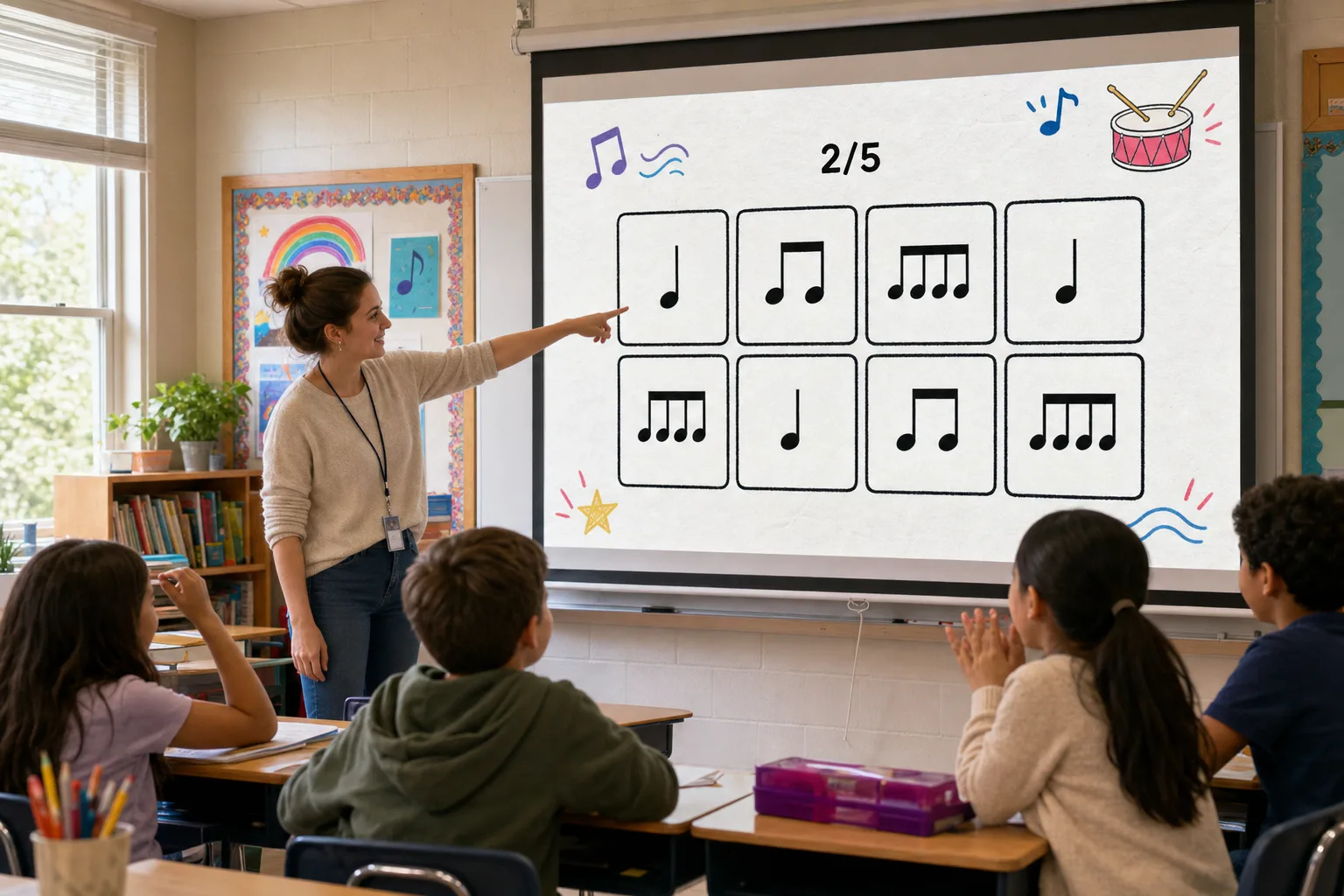
Say the Word on Beat is useful in class for a boring reason: you can explain it in one sentence, run it in two minutes, and stop before the room drifts.
That makes it practical in a way most "engagement" tools are not. It can reset a noisy class or wake up a sleepy one. It can also turn vocabulary review into something students actually say out loud, which is a different experience from circling answers on a worksheet.
Why teachers keep using it
Most "engagement" ideas fall apart because the setup takes longer than the activity. This one needs a projector, a category, and a clear stopping point. Students understand the rule immediately, and you can get out just as quickly.
Where it tends to work best
You do not need to build a lesson around the game. It works best in the awkward spaces that already exist in the day:
- Between subjects: Gives students a clean mental reset before the next task. Run one quick round, then immediately transition into the next block.
- After quiet seatwork: Releases pent-up energy before attention drops. Pick a familiar category such as colors or animals so everyone can join in.
- Morning warm-up: Gets the room talking early and raises the energy floor. Use it as the first activity on the board before attendance or announcements.
- End-of-day review: Keeps review light and memorable. Create a custom deck from that week's key vocabulary.
How to introduce it without losing the room
The launch should be short. Put it on the projector, pick a category, and give one sentence of direction: "Say the picture before the next one appears." Most groups will get it immediately.
- Choose a moment when students need a reset rather than a reward.
- Start with a broad category that no one has to decode.
- Play a short round and join in so students understand the rhythm immediately.
- Stop while the room still wants one more round.
Practical rule: one round is usually enough. The value comes from the reset. Stretch it too long and you lose the sharpness that makes it useful.
Where it becomes instruction instead of just a reset
Generic categories are fine for getting the room moving. Custom decks are where the format becomes more interesting. Once you switch from "animals" to this week's vocabulary, the game stops being filler and starts functioning as oral retrieval practice.
That makes it useful for sight words, unit vocabulary, and language practice. If you are teaching multilingual learners, the image-to-word-to-speech loop is especially useful. The same logic carries over to ESL vocabulary practice.
Deck ideas that are actually useful
- Science: planets, life cycles, rock types, cell parts, weather vocabulary.
- History: historical figures, landmarks, artifacts, events, time periods.
- Math: shapes, number words, symbols, visual equations, geometry terms.
- Reading: sight words, chapter vocabulary, rhyming families, story elements.
What to watch during the first week
The most common mistake is making the deck too hard too early. If half the class cannot answer quickly, the pace collapses. The second mistake is letting the volume run away from you. If that starts happening, switch to whole-class response instead of free-for-all calling out.
It also helps to vary how often you use it. Every transition does not need a rhythm game. Used occasionally, it feels fresh. Used constantly, it becomes background noise.
Why it earns a place in the routine
Teachers do not keep activities because they are trendy. They keep the ones that survive a real Tuesday afternoon. This one sticks around because it takes almost no prep, works as a quick reset or actual review, and does not require you to re-explain the rules every time.