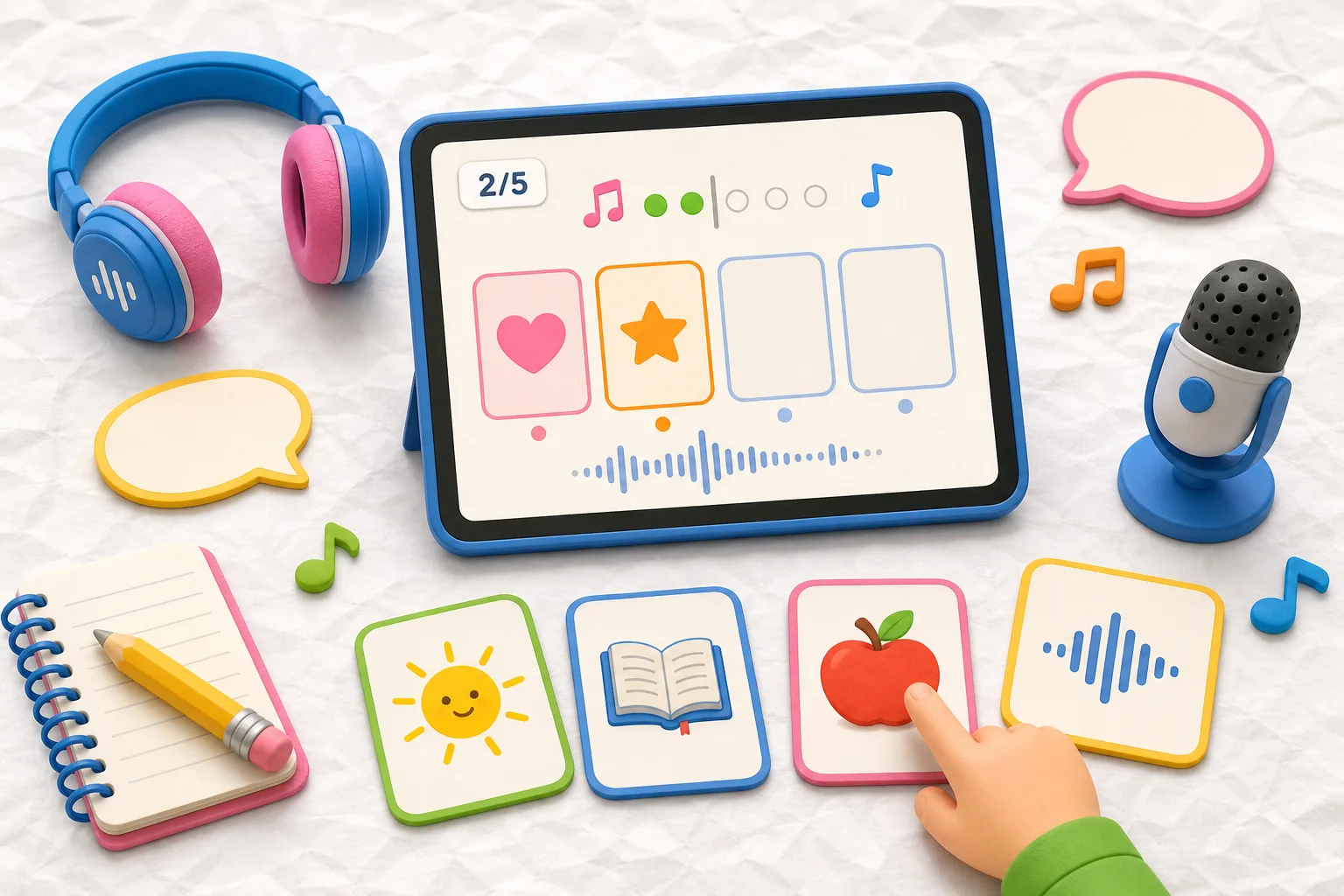
The hard part of vocabulary practice is retrieval, not recognition. Learners often know the word when they see it, but still hesitate when they have to say it quickly. Say the Word on Beat is useful because it targets that exact gap.
An image appears, the beat gives timing, and the learner has to move from seeing to speaking without much delay. That matters because hesitation often lives in that split second between "I know it" and "I can say it."
Why the rhythm helps
The beat adds pacing, not meaning. Learners know when the response should land, so the task becomes less about deciding when to speak and more about retrieving the word in time.
Useful framing: this is not music training. The beat is just a timing cue. It can help with flow and confidence, but it does not replace actual pronunciation feedback when sounds are wrong.
The other advantage is low pressure. Learners are reacting to images, not staring at a blank prompt. That small difference lowers friction for beginners and keeps stronger learners from feeling like they are doing elementary drills.
Deck types that work well for ESL
Concrete, highly visible language works best at the start. Abstract or tricky vocabulary can come later once learners are comfortable with the format.
- Concrete nouns: Pictures are clear, so learners can focus on retrieval instead of interpretation. Best for beginners and mixed-level groups.
- Classroom vocabulary: High-frequency words benefit from repeated oral recall. Best for warm-ups and weekly review.
- Chapter or unit words: Custom decks tie the game to what learners actually need next. Best for test prep and end-of-unit review.
- Rhyming or sound-contrast sets: They make sound differences easier to hear, repeat, and notice under pressure. Best for phonics work and early pronunciation practice.
How to use it in class
As a classroom tool, it works best as a short warm-up, transition, or review round. One or two quick passes are usually enough. The point is fast recall, not a long performance.
- Use a familiar category before a lesson to get mouths moving early.
- After introducing new vocabulary, run a custom deck to check whether students can retrieve the words right away.
- At the end of class, use it as oral review — quicker and more active than another worksheet exit task.
How to use it alone
For self-study, five minutes is enough. Start with a generic deck to warm up, then move into a custom set built from the words you keep missing. It works especially well when you rotate between recognition practice and spoken production.
What it helps with and what it does not
This format builds speed, recall, and spoken confidence. It does not explain grammar, replace conversation practice, or correct pronunciation by itself. Think of it as one layer inside a normal learning routine — not the whole thing.
If your context is classroom-heavy, pair this article with the teacher-focused guide on using the game in class. If your learners are younger, the kids guide is the more useful companion.